The Hype Cycle and the Chasm

Each year, analyst firm Gartner publishes their hype cycle on emerging technologies. I find this makes for a useful filter when reading all the news coming out of big software companies. For example, all you hear about in the tech press these days is about AI, virtual reality, and self-driving cars.
Well, the next time you're out driving during a snowstorm in a gritty, decaying, chaotic city like Montreal or Detroit, ask yourself how a self-driving car would cope.
Gartner plots these technologies on a curve that shows how a technology typically progresses against our inflated expectations:

http://www.gartner.com/newsroom/id/3412017
Gartner also publishes Hype Cycles for various market segments such as social software, supply chain, digital marketing , CRM, etc. I don't know where what we do sits on their hype cycle (the industry hype cycle reports cost a fortune) but I'd guess that 'external communities' or 'peer to peer support' would be well on its way past the plateau of productivity.
Another way to look at a new technology is the adoption curve as famously described by Geoffrey Moore in 1991. He proposed an adoption curve that sees more and more people adopting a technology over time with one hitch. He claims there is a chasm between the early adopters and the early majority.
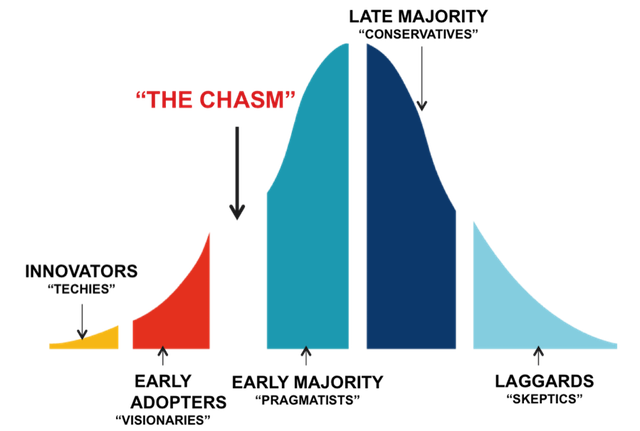
I like to think that customer community software has just crossed the chasm. It's not just media, video game and high tech companies that are setting up customer communities, we're seeing it in finance, consumer durables, b2b, etc. For example, this month we are talking to a company that provides supplies such as cafeteria trays and orange overalls to prisons - not exactly your cutting edge kind of company.
All this to say that I feel we are in a good spot and not be too concerned with some of the hype out there. We have time to explore and adopt new technologies such as AI as they transition from over hyped to practical and productive.
Comments
-
I was just reading about how "machine learning" currently, in many cases, produces roughly equivalent results to a (vastly simpler, tried-and-true) recommendation engine. For, oh I dunno, 10x the cost/effort. I have a bit of a allergy against liking whatever is the coolest thing on Hacker News currently and it rarely lets me down. When you're dealing with tooling, it's OK to play on the front of the curve. When it's your core platform, you'd better be riding the back of that wave unless your R&D budget is $$$$.
0